Heat pump and refrigeration cycle
From Wikipedia, the free encyclopedia
For details of practical heat pumps, see
Heat pump.
Thermodynamic
heat pump cycles or
refrigeration cycles are the conceptual and
mathematical models for
heat pumps and
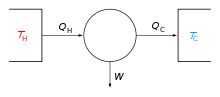
refrigerators. A heat pump is a machine or device that moves
heat
from one location (the "source") at a lower temperature to another
location (the "sink" or "heat sink") at a higher temperature using
mechanical work or a high-temperature heat source.
[1]
Thus a heat pump may be thought of as a "heater" if the objective is to
warm the heat sink (as when warming the inside of a home on a cold
day), or a "refrigerator" if the objective is to cool the heat source
(as in the normal operation of a freezer). In either case, the operating
principles are identical.
[2] Heat is moved from a cold place to a warm place.
Thermodynamic cycles
According to the
second law of thermodynamics heat cannot spontaneously flow from a colder location to a hotter area;
work is required to achieve this.
[3]
An air conditioner requires work to cool a living space, moving heat
from the cooler interior (the heat source) to the warmer outdoors (the
heat sink). Similarly, a refrigerator moves heat from inside the cold
icebox (the heat source) to the warmer room-temperature air of the
kitchen (the heat sink). The operating principle of the
refrigeration cycle was described mathematically by
Sadi Carnot in 1824 as a
heat engine. A heat pump can be thought of as a
heat engine which is operating in reverse.
Heat pump and refrigeration cycles can be classified as
vapor compression,
vapor absorption,
gas cycle, or
Stirling cycle types.
Vapor-compression cycle
The vapor-compression cycle is used in most household refrigerators
as well as in many large commercial and industrial refrigeration
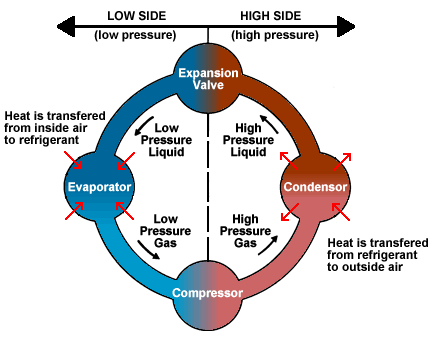
systems. Figure 1 provides a schematic diagram of the components of a
typical vapor-compression refrigeration system.

Figure 1: Vapor-compression refrigeration
The
thermodynamics of the cycle can be analysed on a diagram
[4][5] as shown in Figure 2. In this cycle, a circulating
refrigerant such as
Freon enters the
compressor as a vapor. The vapor is compressed at constant
entropy and exits the compressor
superheated. The superheated vapor travels through the
condenser
which first cools and removes the superheat and then condenses the
vapor into a liquid by removing additional heat at constant pressure and
temperature. The liquid refrigerant goes through the
expansion valve (also called a throttle valve) where its pressure abruptly decreases, causing
flash evaporation and auto-refrigeration of, typically, less than half of the liquid.
That results in a mixture of liquid and vapor at a lower temperature
and pressure. The cold liquid-vapor mixture then travels through the
evaporator coil or tubes and is completely vaporized by cooling the warm
air (from the space being refrigerated) being blown by a fan across the
evaporator coil or tubes. The resulting refrigerant vapor returns to
the compressor inlet to complete the thermodynamic cycle.
The above discussion is based on the ideal vapor-compression
refrigeration cycle, and does not take into account real-world effects
like frictional pressure drop in the system, slight
thermodynamic irreversibility during the compression of the refrigerant vapor, or
non-ideal gas behavior (if any).
Vapor absorption cycle
In the early years of the twentieth century, the vapor absorption
cycle using water-ammonia systems was popular and widely used but, after
the development of the vapor compression cycle, it lost much of its
importance because of its low
coefficient of performance
(about one fifth of that of the vapor compression cycle). Nowadays, the
vapor absorption cycle is used only where heat is more readily
available than electricity, such as
waste heat provided by
solar collectors, or
off-the-grid refrigeration in
recreational vehicles.
The absorption cycle is similar to the compression cycle, except for
the method of raising the pressure of the refrigerant vapor. In the
absorption system, the compressor is replaced by an absorber which
dissolves the refrigerant in a suitable liquid, a liquid pump which
raises the pressure and a generator which, on heat addition, drives off
the refrigerant vapor from the high-pressure liquid. Some work is
required by the liquid pump but, for a given quantity of refrigerant, it
is much smaller than needed by the compressor in the vapor compression
cycle. In an absorption refrigerator, a suitable combination of
refrigerant and absorbent is used. The most common combinations are
ammonia (refrigerant) and water (absorbent), and water (refrigerant) and
lithium bromide (absorbent).
Gas cycle
When the working fluid is a gas that is compressed and expanded but does not change phase, the refrigeration cycle is called a
gas cycle.
Air
is most often this working fluid. As there is no condensation and
evaporation intended in a gas cycle, components corresponding to the
condenser and evaporator in a vapor compression cycle are the hot and
cold gas-to-gas
heat exchangers.
For given extreme temperatures, a gas cycle may be less efficient
than a vapor compression cycle because the gas cycle works on the
reverse
Brayton cycle instead of the reverse
Rankine cycle.
As such, the working fluid never receives or rejects heat at constant
temperature. In the gas cycle, the refrigeration effect is equal to the
product of the specific heat of the gas and the rise in temperature of
the gas in the low temperature side. Therefore, for the same cooling
load, gas refrigeration cycle machines require a larger mass flow rate,
which in turn increases their size.
Because of their lower efficiency and larger bulk,
air cycle coolers are not often applied in terrestrial refrigeration. The
air cycle machine is very common, however, on
gas turbine-powered
jet airliners
since compressed air is readily available from the engines' compressor
sections. These jet aircraft's cooling and ventilation units also serve
the purpose of heating and pressurizing the
aircraft cabin.
Stirling engine
The
Stirling cycle
heat engine can be driven in reverse, using a mechanical energy input
to drive heat transfer in a reversed direction (i.e. a heat pump, or
refrigerator). There are several design configurations for such devices
that can be built. Several such setups require rotary or sliding seals,
which can introduce difficult tradeoffs between frictional losses and
refrigerant leakage.
Reversed Carnot cycle
Since
the Carnot cycle is a reversible cycle, the four processes that
comprise it, two isothermal and two isentropic, can all be reversed as
well. When this happens, it is called a reversed Carnot cycle. A
refrigerator or heat pump that acts on the reversed Carnot cycle is
called a Carnot refrigerator and Carnot heat pump respectively. In the
first stage of this cycle (process 1-2), the refrigerant absorbs heat
isothermally from a low-temperature source, T
L, in the amount Q
L. Next, the refrigerant is isentropically compressed (process 2-3) and the temperature rises to the high-temperature source, T
H. Then at this high temperature, the refrigerant rejects heat isothermally in the amount Q
H
(process 3-4). Also during this stage, the refrigerant changes from a
saturated vapor to a saturated liquid in the condenser. Lastly, the
refrigerant expands isentropically where the temperature drops back to
the low-temperature source, T
L (process 4-1).
[2]
Coefficient of performance
The efficiency of a refrigerator or heat pump is given by a parameter called the
coefficient of performance (COP).
The COP of a refrigerator is given by the following equation:
- COP = Desired Output/Required Input = Cooling Effect/Work Input = QL/Wnet,in
The COP of a heat pump is given by the following equation:
- COP = Desired Output/Required Input = Heating Effect/Work Input = QH/Wnet,in
Both the COP of a refrigerator and a heat pump can be greater than one. Combining these two equations results in:
- COPHP = COPR + 1 for fixed values of QH and QL
This implies that COP
HP will be greater than one because COP
R
will be a positive quantity. In a worst-case scenario, the heat pump
will supply as much energy as it consumes, making it act as a resistance
heater. However, in reality, as in home heating, some of Q
H is lost to the outside air through piping, insulation, etc., thus making the COP
HP drop below unity when the outside air temperature is too low. Therefore, the system used to heat houses uses fuel.
[2]
For an ideal refrigeration cycle:
- COP = TL/(TH-TL)
For an ideal heat pump cycle:
- COP = TH/(TH-TL)
For Carnot refrigerators and heat pumps, COP is expressed in terms of temperatures:
- COPR,Carnot = 1/((TH/TL) - 1)
- COPHP,Carnot = 1/(1 - (TL/TH))